
The Receipt
How Many Minutes of Work Is a Pound of Ground Beef Now?
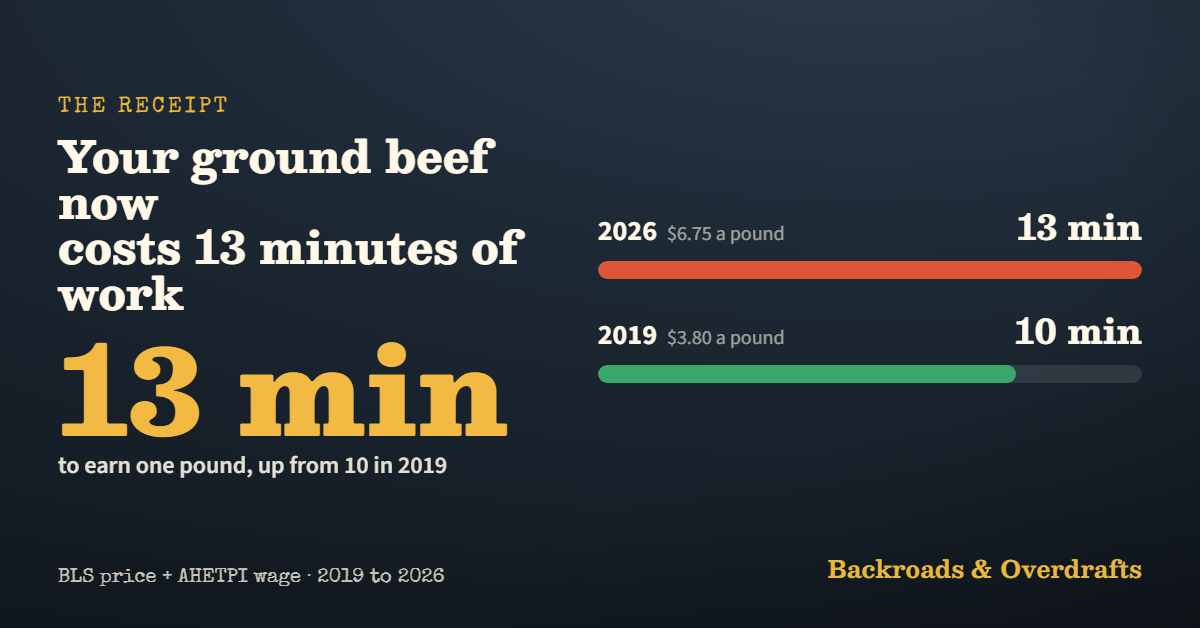
Priced in minutes of work instead of dollars, a pound of ground beef went from about 10 minutes in 2019 to about 13 today. Eggs barely budged. Here is the gap people actually feel.
There is one line that shows up in every cost-of-living conversation, at every kitchen table, in every comment section. Everything goes up except the paycheck.
It is the most repeated complaint in the whole money conversation, and almost nobody checks it the obvious way. We argue about prices in dollars and wages in dollars, in two separate fights. But the thing people actually feel is the trade. You do not buy groceries with dollars. You buy them with the hours you spent earning the dollars.
So here is the same receipt, priced in minutes of work.
In January 2019, a pound of ground beef cost $3.80. The typical worker, meaning the production and non-supervisory crowd that makes up most of the workforce, earned $23.13 an hour. Do the division and that pound cost about 10 minutes of work.
By May 2026, the same pound is $6.75. The same typical wage is up to $32.31 an hour. That pound now costs about 13 minutes of work.
The price almost doubled. The wage went up a lot too. And the honest answer is the one in the middle: the beef still got more expensive in the only currency that matters, but by three minutes, not by the full sticker shock the price tag implies.
The part that surprised me
Eggs tell a different story, and it is worth sitting with because it is the opposite of what you would guess.
A dozen eggs ran $1.55 in January 2019. That was about 4 minutes of work at the typical wage. Today eggs are $2.19, and that is still about 4 minutes of work. In dollars, eggs jumped more than 40 percent. In minutes of your day, they basically did not move, because the typical wage climbed right alongside them.
That is the whole point of pricing things this way. The dollar number can scream while the work-minutes number shrugs, and they are both true. Eggs feel expensive because we remember the dollar. The clock says you are spending about the same slice of your morning on them as you were before.
Useful source trail: the grocery prices are BLS average city prices and the wage series is FRED AHETPI. If you want to check the economic series directly, start with FRED and the BLS public CPI data page.
So is the complaint wrong?
No. It is just aimed at the wrong groceries.
The “everything goes up except wages” feeling is real, but it is not evenly real. Some staples genuinely got heavier to carry. Ground beef is one of them, up about three minutes a pound, which is a 27 percent jump in work-time. Others, like eggs, mostly kept pace once you measure the trade instead of the sticker.
The catch is that wages are an average, and you are not an average. If your pay did not climb from roughly $23 to $32 an hour over those years, then none of this softening happened for you. For you the dollar number is the whole story, and the beef really did get a lot heavier. The typical-worker wage is the most generous honest yardstick there is, and even by that yardstick the beef cost you more time.
This is the same squeeze we keep finding when we slow down and measure it. It is why a fixed-income raise stopped keeping up with the grocery shelf, and it is the human version of why the same name-brand cart costs more now than it used to. If you want to see how far the same paycheck stretches depending on where you stand, a paycheck quietly goes furthest in cities nobody brags about.
Why minutes beat dollars
Dollars are noisy. A dollar in 2019 and a dollar in 2026 do not feel the same because wages moved too. Minutes of work brings the grocery shelf back to the body.
A good work-minute chart answers one plain question: how long did the typical worker have to stay on the clock for this item?
Use it carefully:
- It is pre-tax, so take-home pay can feel tighter.
- It uses a broad wage series, not your exact job.
- It works best for simple items like eggs or ground beef, where the unit is clear.
That is why this page is a comparison tool, not a verdict on any one household.
The caveat
These are national average prices, not your store, and pre-tax wages, not your take-home. The minutes are honest arithmetic, but they assume you earn the typical wage and that taxes do not bite first, and both of those are softer in real life. Treat the numbers as the shape of the thing, not a promise about your specific Tuesday.
But the shape is the point. Next time someone says everything went up except your paycheck, you can answer in the only unit that does not lie. Some of it did. Some of it just felt like it did.
So pick the thing you buy every single week. How many minutes of work does it cost you now, and does that feel like more or less than it used to?
Sources: BLS average city prices for ground beef (APU0000703112) and eggs (APU0000708111) via FRED, and the typical-worker wage, BLS Average Hourly Earnings of Production and Nonsupervisory Employees (AHETPI) via FRED. Minutes of work = price divided by the hourly wage, pre-tax. Compares January 2019 with May 2026. Pulled 2026-06-13.
Keep reading
More from The Receipt
 The Receipt
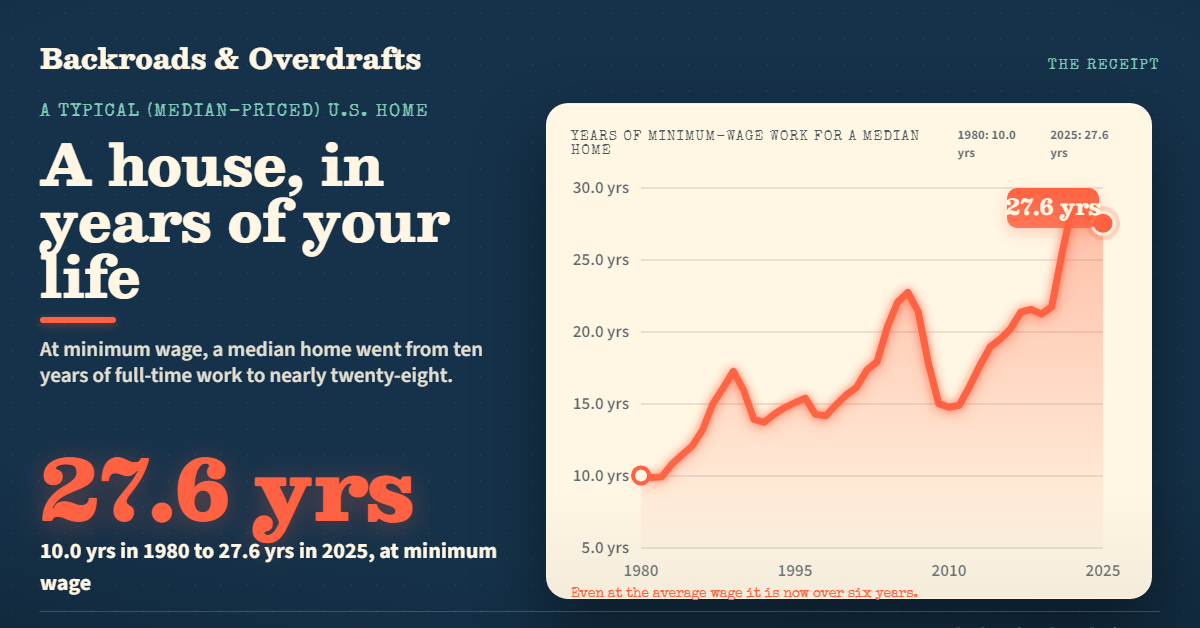
A House Used to Cost 4 Years of Work. Now It Is Closer to 6 and a Half.
Measured in years of full-time work instead of dollars, a typical American home went from about 4.5 years of the average wage in 1980 to 6.4 today, and from 10 years to nearly 28 at minimum wage. The median price climbed from $64,750 to $415,400.
 The Receipt
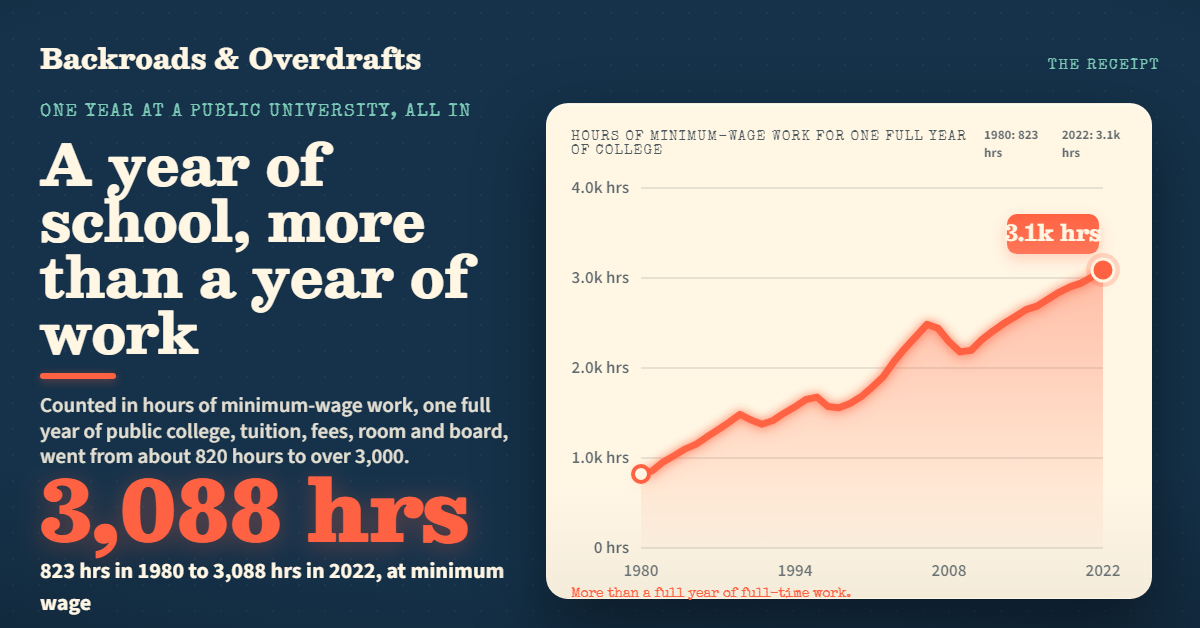
A Year of College Now Costs More Than a Year of Work
Add up everything one year at a public university actually costs, tuition, fees, room and board, and price it in hours of work. It went from about 820 hours of minimum-wage work in 1980 to over 3,000 today. The bill climbed from $2,550 to $22,389.
 The Receipt
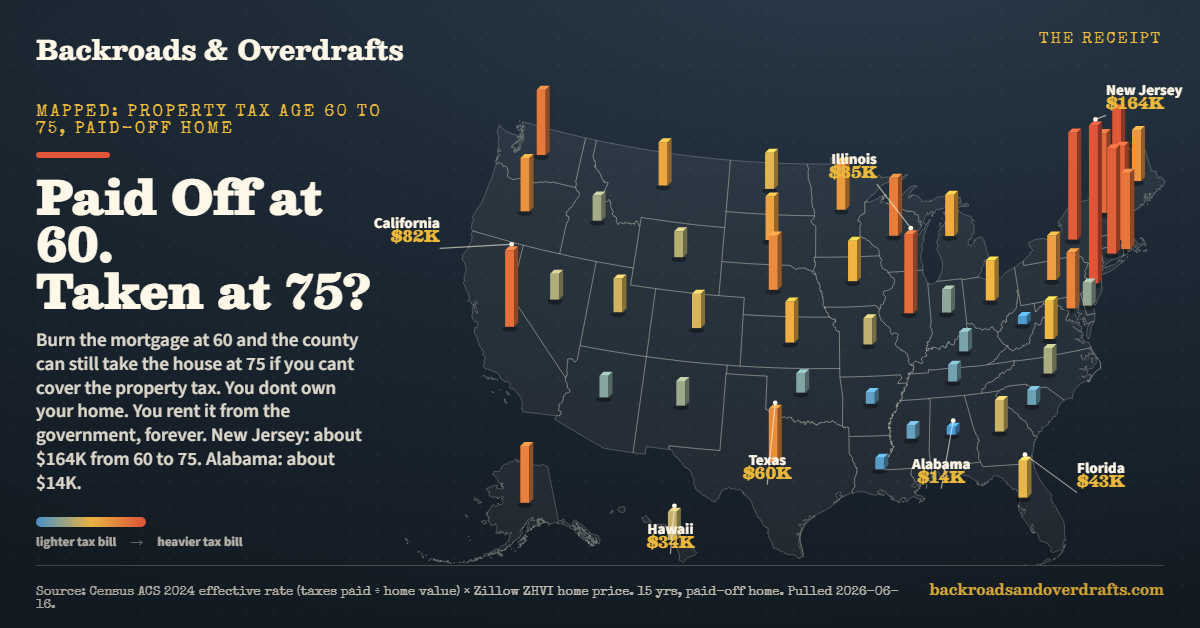
The House Is Paid Off. The Tax Never Is.
Pay off your mortgage at 60 and the county still bills you every year. We mapped what 15 years of property tax costs on a paid-off home in all 50 states. New Jersey, about $164,000. Alabama, about $14,000.