
The Receipt
A Year of College Now Costs More Than a Year of Work
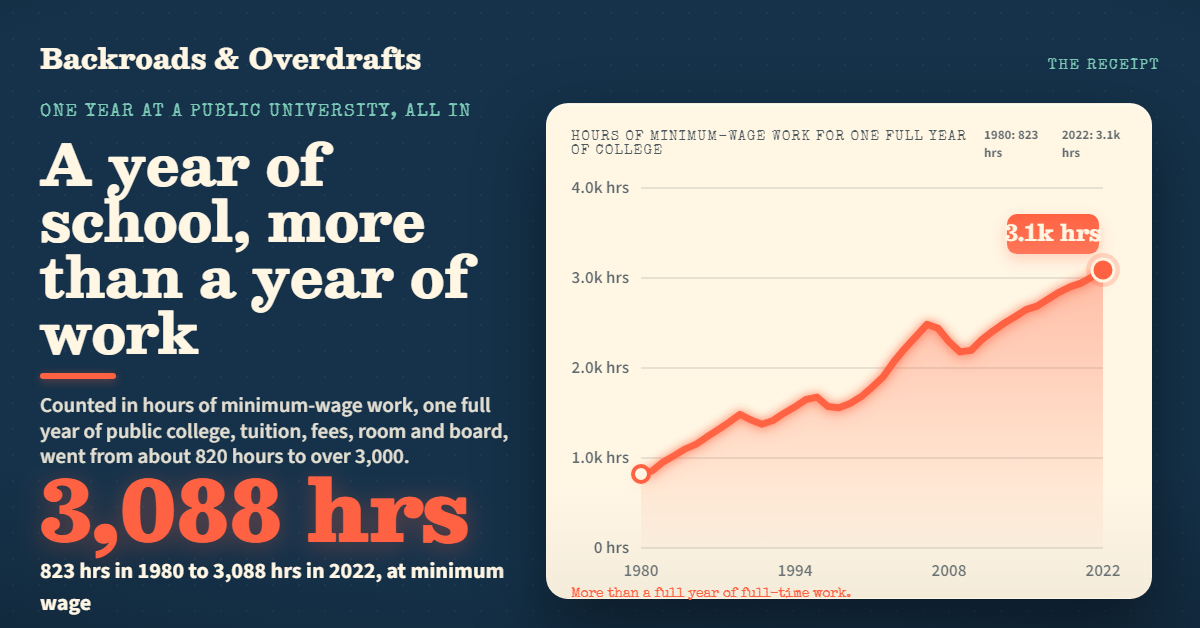
Add up everything one year at a public university actually costs, tuition, fees, room and board, and price it in hours of work. It went from about 820 hours of minimum-wage work in 1980 to over 3,000 today. The bill climbed from $2,550 to $22,389.
Ask anyone over 60 how they paid for college and you will hear some version of the same story. They worked. Summers, weekends, a campus job, and somehow it was enough to get through without a mountain of debt. It is the kind of story that ends with “and I paid my own way,” usually followed by a quiet question about why kids today cannot just do the same.
Here is the honest answer, in the only unit that actually compares one generation to the next. Not dollars. Hours of work. And not just tuition, because college was never just tuition. The whole thing: tuition, fees, a place to sleep, and food to eat for a year.
Why measure college in hours instead of dollars
A dollar in 1980 and a dollar today are not the same thing, so comparing a $2,550 bill to a $22,389 one tells you almost nothing on its own. Wages were lower then too. The only fair question is how much of your life the bill actually costs: how many hours you have to clock to pay it.
So we took the average total cost of one year at a four-year public university, in-state, living on campus, straight from the federal Digest of Education Statistics. That is tuition plus required fees plus room and board, the real number a family has to cover, not just the line at the top of the invoice. Then we divided each year’s total by what an hour of work paid that same year, at two wages: the federal minimum wage, and the average wage for a typical working American.
What a year used to cost
In 1980, a full year at a public university averaged about $2,550. The federal minimum wage was $3.10 an hour. Do the division and a year of college cost roughly 823 hours of minimum-wage work.
That is about 20 weeks of full-time work. Not nothing, but reachable: a hard summer plus a part-time job through the year, and a determined 18-year-old really could cover most of it. The “I worked my way through” story was not a tall tale. At those numbers it was doable.
What it costs now
By 2022, the most recent year in the federal data, the all-in cost of a year at a public university had climbed to $22,389. Minimum wage had risen too, to $7.25, but nowhere near fast enough. A year of college now costs about 3,088 hours of minimum-wage work.
That is more than a full year of full-time work, every hour of it, for a single year of school. You could work 40 hours a week, every week, with no vacation, and still not cover one year before the next tuition bill arrived. The summer job did not get lazier. The mountain got taller.
| Year | Total cost (tuition, fees, room, board) | At minimum wage | At the average wage |
|---|---|---|---|
| 1980 | $2,550 | 823 hrs | 372 hrs |
| 1990 | $5,243 | 1,422 hrs | 514 hrs |
| 2000 | $8,653 | 1,680 hrs | 618 hrs |
| 2010 | $15,919 | 2,196 hrs | 836 hrs |
| 2022 | $22,389 | 3,088 hrs | 812 hrs |
It is not just a minimum-wage problem
It would be easy to wave this away as a minimum-wage story, the kind of thing that only matters to teenagers in their first jobs. It is not.
Run the same math at the average wage for a typical worker and a year of college still went from about 372 hours of work in 1980 to 812 hours in 2022. It more than doubled. There is even a quirk worth noticing: at the average wage the number actually dipped slightly between 2010 and 2022, because typical wages finally grew faster than college costs for a stretch. But “slightly better than the worst point in living memory” is not the same as affordable. For an average earner, a single year of public college is still the better part of half a year of full-time pay, every year, for four years.
The gap between the two lines is the whole point. When a cost rises faster than the lowest wages and faster than the average wage, it is not a story about lazy kids or bad budgeting. It is a story about a price that simply left the paycheck behind.
Why college ran away from the paycheck
Two things happened at once. Published tuition at public universities rose much faster than wages, especially from 2000 to 2010 when it roughly doubled, largely because state funding per student fell and schools shifted the cost onto families. At the same time, room and board, the part nobody can avoid because students have to live somewhere, kept climbing right alongside it. Add them together and you get a number that grew far faster than an hour of work was ever worth.
A few honest notes on the figure:
- It is in-state, public, on-campus. Out-of-state, private, and pricier housing markets run much higher. This is the affordable end.
- It is the published cost, before grants and scholarships. Lower-income students often pay less than this through Pell Grants and aid, which do not have to be repaid. The sticker is still what families plan around and what loans are sized against.
- It actually understates the full bill. It does not include books, supplies, transportation, or personal expenses, which colleges fold into their official “cost of attendance” and which push the real number higher still.
What this actually means at the kitchen table
If you are the parent in that old story, the math is not a guilt trip. It is permission to stop blaming the kid. The path that worked for you closed sometime in the 1990s, and no amount of hustle reopens it when one year costs more than a year of full-time work.
If you are the one staring down the bill now, the hours are the enemy, so anything that cuts the hours helps:
- Live at home or start at a community college. Room and board is roughly half the all-in number. Cutting it, even for two years, changes the math more than any scholarship most students will see.
- Stay in-state. These are in-state public averages. Out-of-state and private push the work-hours into genuinely impossible territory.
- File the FAFSA even if you think you will not qualify. Pell Grants and need-based aid are the difference between the sticker here and the net price, and they are not loans.
- Do the work-hours math before you borrow, not after. A loan is just future hours of work with interest stacked on top. Knowing a year already costs 3,000-plus hours at minimum wage makes the size of a loan feel like what it is.
The summer job did not fail anyone. It just stopped being able to do a job that now takes more than a full year of work. That is not nostalgia. It is arithmetic, and it is worth showing your kid before the next bill arrives.
If you like seeing prices in hours of your life instead of dollars, we do this a lot. See how many minutes of work a pound of groceries costs now, what a house costs in years of work, and how Social Security raises stack up against grocery prices.
You can check the raw numbers yourself: the cost of college lives in the NCES Digest of Education Statistics, Table 330.10, and the wage series are on FRED (typical-worker wages and the federal minimum wage).
Sources: average total tuition, fees, room, and board at 4-year public institutions (in-state, on-campus), current dollars, from the National Center for Education Statistics Digest of Education Statistics, Table 330.10. Wages from FRED: Average Hourly Earnings of Production and Nonsupervisory Employees (AHETPI) and the federal minimum wage (FEDMINNFRWG). Hours of work = total cost divided by the hourly wage, pre-tax. 1980 through 2022. Pulled 2026-06-16.
Keep reading
More from The Receipt
 The Receipt
A House Used to Cost 4 Years of Work. Now It Is Closer to 6 and a Half.
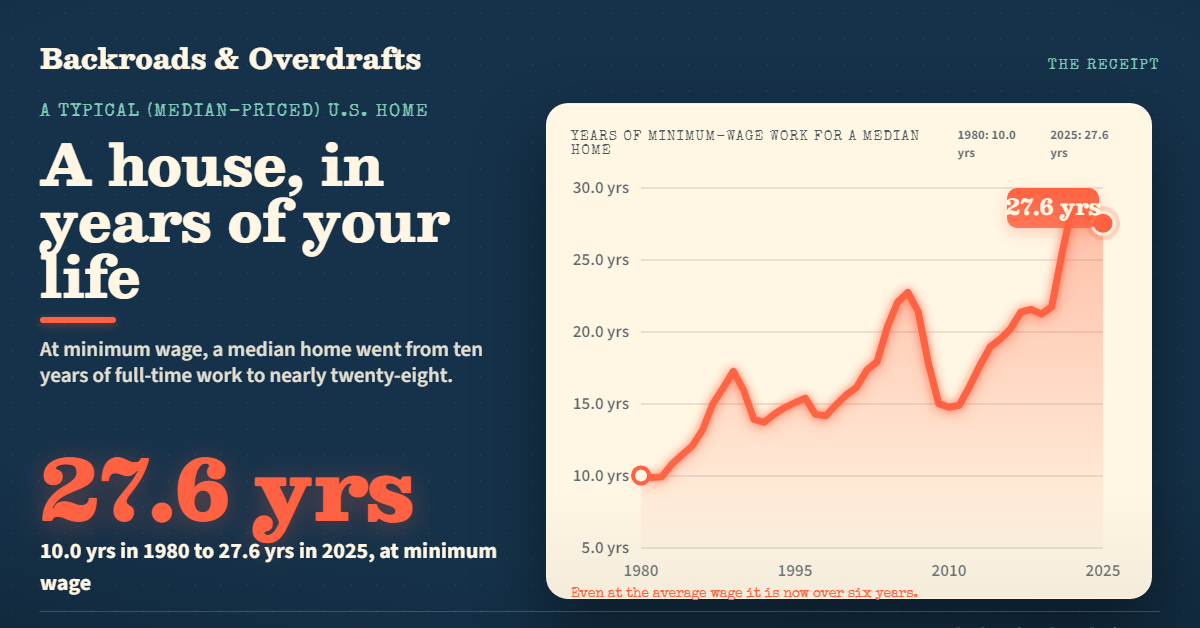
Measured in years of full-time work instead of dollars, a typical American home went from about 4.5 years of the average wage in 1980 to 6.4 today, and from 10 years to nearly 28 at minimum wage. The median price climbed from $64,750 to $415,400.
 The Receipt
The House Is Paid Off. The Tax Never Is.
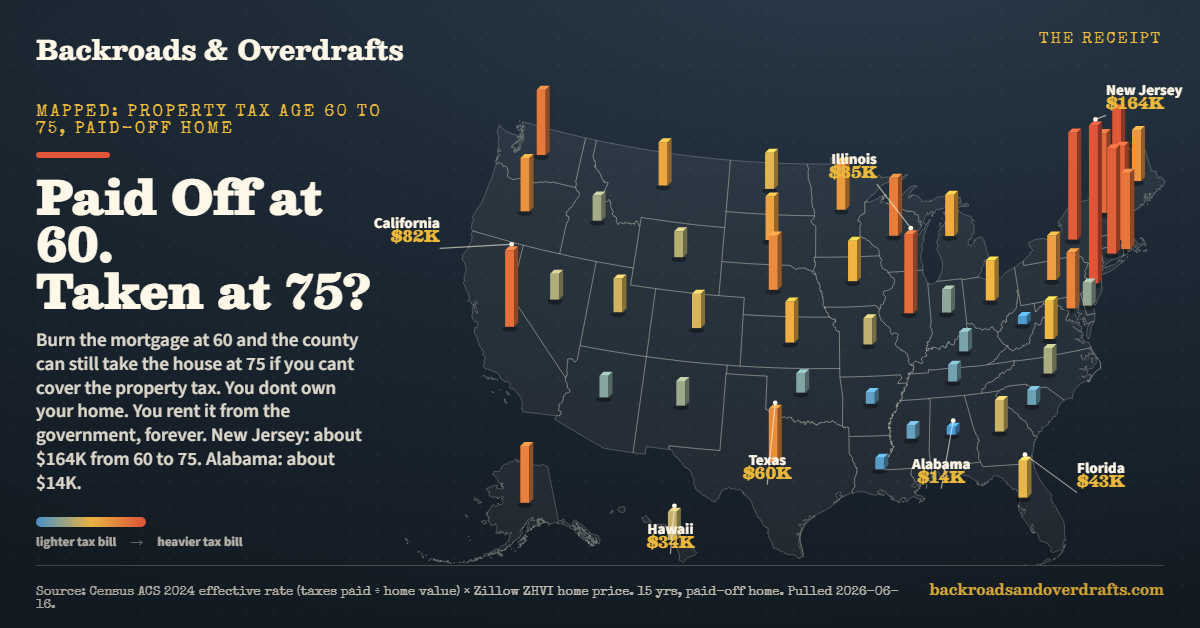
Pay off your mortgage at 60 and the county still bills you every year. We mapped what 15 years of property tax costs on a paid-off home in all 50 states. New Jersey, about $164,000. Alabama, about $14,000.
 The Receipt
Watch Ground Beef Quadruple, and the Steak Dinner Walk Off
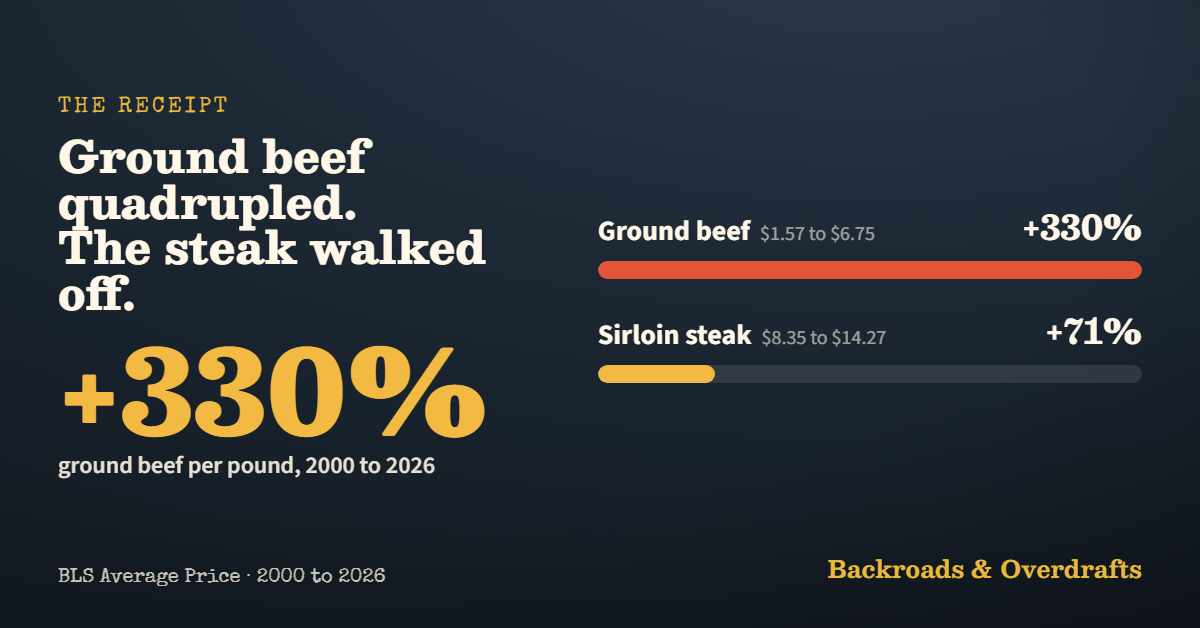
Two animated charts of the meat case. Ground beef went from $1.57 a pound in 2000 to $6.75. The nice steak climbed 71% in just seven years. Here is the run, year by year.