
The Receipt
How Much of Your Egg Money Actually Reaches the Farm
You pay $2.19 for a dozen eggs. The farmer who raised the hens gets about 85 cents of it. Here's where the rest of your grocery dollar goes.
You’re standing at the register and the eggs ring up at a couple bucks, and somewhere in the back of your head there’s a picture of a farmer in a barn at five in the morning. So it feels natural to assume that when prices climb, most of that extra money is landing in his pocket. That’s who did the hard part, right.
Then you actually trace where the money goes, and the picture doesn’t match the feeling at all.
The USDA tracks what farmers get paid for what they raise. The Bureau of Labor Statistics tracks what you pay at the store. Line the two up on the same item and you get a number nobody puts on the carton: how much of your grocery dollar ever reaches the person who grew the food.
The egg, traced
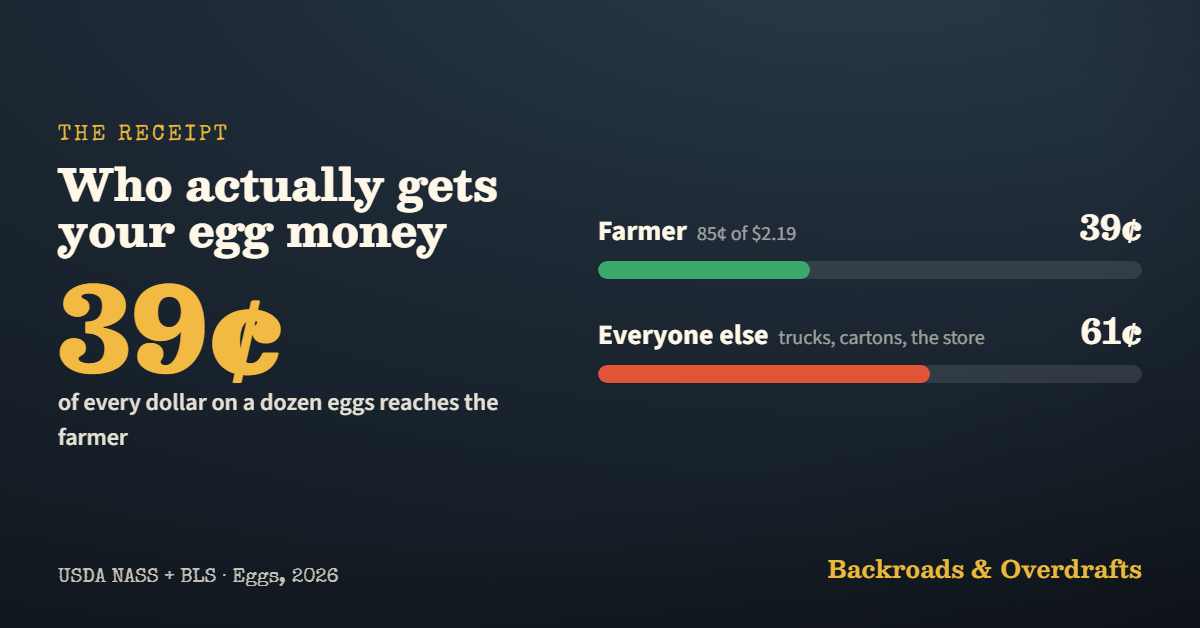
Here’s the one that surprised me. A dozen eggs rang up at a national average of $2.19 in May. The price the farmer actually received for that same dozen back in April was about 85 cents.
So the farmer’s cut is 39 percent. The other 61 cents on the dollar never reaches the farm. It goes to grading and washing and cartoning, the cold trucks, the warehouse, the store’s rent and labor and markup, and the slice every middle step keeps along the way.
That’s eggs, which is actually one of the simpler trips a food makes. An egg basically rolls from the hen to your carton. There’s not much you can do to an egg.
Now do milk, where the gap is smaller
Milk tells a slightly friendlier version of the same story. A gallon averaged $4.22 at the store in May. The dairy farmer received about $1.79 for the milk in that gallon.
That’s a 42 percent farmer’s share. A little better than eggs, and there’s a reason. Raw milk has to be hauled cold, pasteurized, bottled, and rushed to shelves before it turns, so more of the dollar is real work that has to happen no matter what. Even then, the farmer keeps under half.
Two staples, two numbers, same shape: the person who did the farming walks away with roughly 40 cents on your dollar, and they were the cheapest part of your trip.
Why this matters when prices jump
The useful part of this isn’t outrage. It’s that it changes what you do with the next headline.
When egg prices spike, the easy assumption is that farmers are cashing in. But if the farmer’s slice is already the small one, a price jump is usually happening somewhere in that 61-cent stretch between the barn and the bag, where most of the cost already lived. A bird flu cull, a fuel bill, a packaging contract, a grocery chain protecting its margin. The farm is rarely the lever.
It also reframes the part of your bill you can actually push on. The cheapest item on the shelf and the farmer’s paycheck are basically the same conversation, which is why buying the plain dozen, the store-brand gallon, the thing without three layers of branding on it, saves real money. You’re not stiffing the farmer. The farmer was already getting paid about the same either way. You’re skipping the middle.
We’ve watched this exact squeeze from the other end too. The same grocery cart that quietly tripled since 1980 climbed for these same reasons, mostly the steps after the farm. And when a paycheck stretches further in one city than another, the grocery line is doing a lot of the work. Even Social Security raises keep falling behind the grocery aisle, and the gap is built out of these same in-between costs.
Why the farmer share is not the whole story
The farm share is useful because it breaks the grocery receipt into pieces. It also keeps the conversation honest. A high egg price at the store does not automatically mean the farmer got rich, and a low farm share does not automatically mean the store did something crooked.
Between farm and checkout you still have grading, packing, trucking, refrigeration, breakage, rent, labor, and the store margin. Some of those costs are real. Some deserve scrutiny. The point is to stop treating the shelf price as one simple number.
Useful source trail: this page names USDA NASS farm prices, BLS retail prices, and FRED-hosted series. The public USDA local food and market doorway is USDA AMS Local Food Directories.
The fine print
These are national averages, and the farmer and retail numbers come from months that are close but not identical, so treat the cents as honest ballparks, not a receipt down to the penny. Unit conversions, like turning the dairy industry’s hundredweight into a gallon, are approximate. Different foods split very differently. A boxed cereal hands the farmer a much thinner slice than an egg does, because there’s a lot more factory between the field and the box.
But the headline holds across the staples we can trace cleanly. The farm is the small slice. The trip is the expensive part.
So next time eggs jump and somebody blames the farmer, you’ve got the actual split in your back pocket. Pull a carton out of your fridge right now. Of what you paid for it, how much do you think made it back to the barn?
Source: USDA NASS price received by farmers vs BLS retail price (via FRED), farmer's share of the food dollar, eggs and milk, pulled 2026-06-13. Snapshots: data/snapshots/farm-share/farm-share-eggs-2026-04.json and farm-share-milk-2026-04.json.
Keep reading
More from The Receipt
 The Receipt
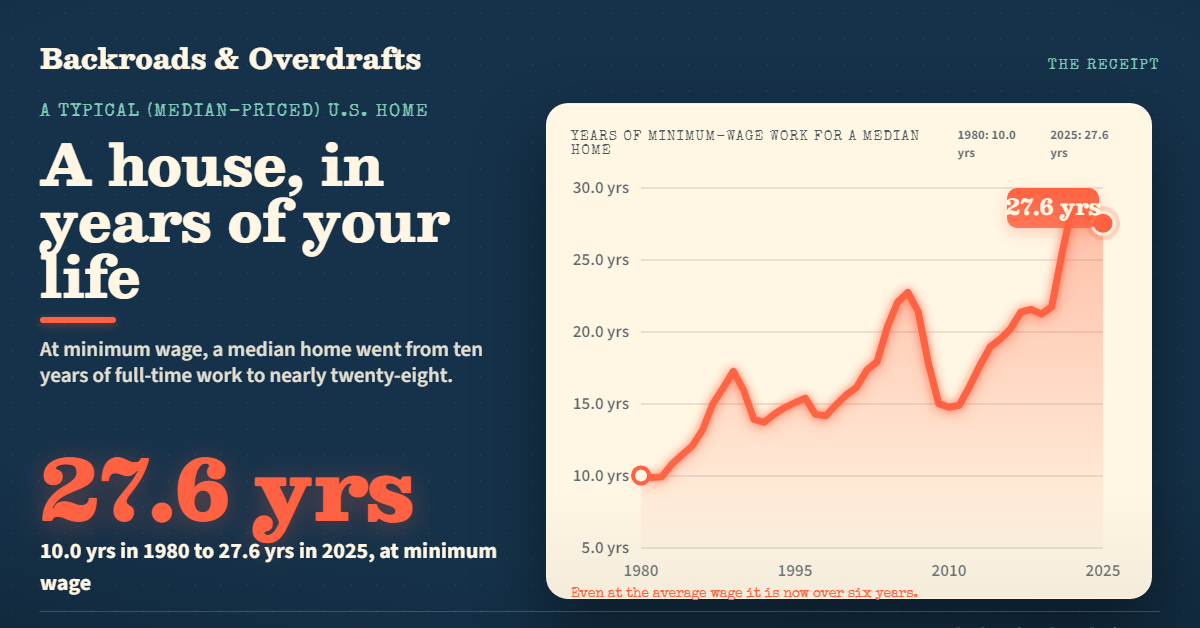
A House Used to Cost 4 Years of Work. Now It Is Closer to 6 and a Half.
Measured in years of full-time work instead of dollars, a typical American home went from about 4.5 years of the average wage in 1980 to 6.4 today, and from 10 years to nearly 28 at minimum wage. The median price climbed from $64,750 to $415,400.
 The Receipt
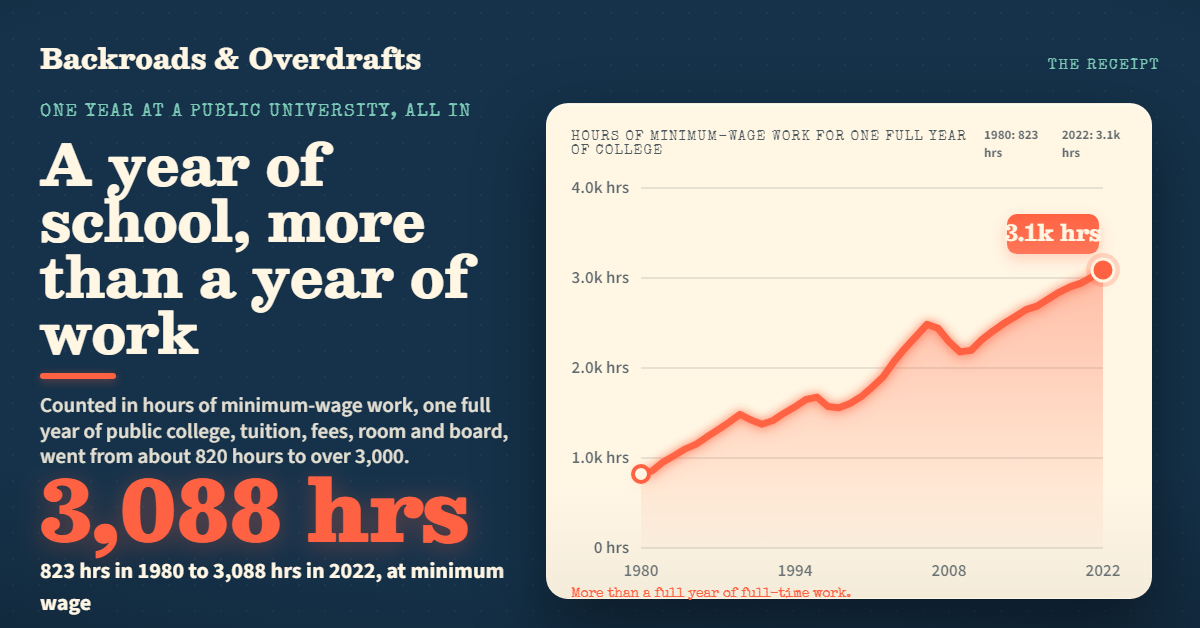
A Year of College Now Costs More Than a Year of Work
Add up everything one year at a public university actually costs, tuition, fees, room and board, and price it in hours of work. It went from about 820 hours of minimum-wage work in 1980 to over 3,000 today. The bill climbed from $2,550 to $22,389.
 The Receipt
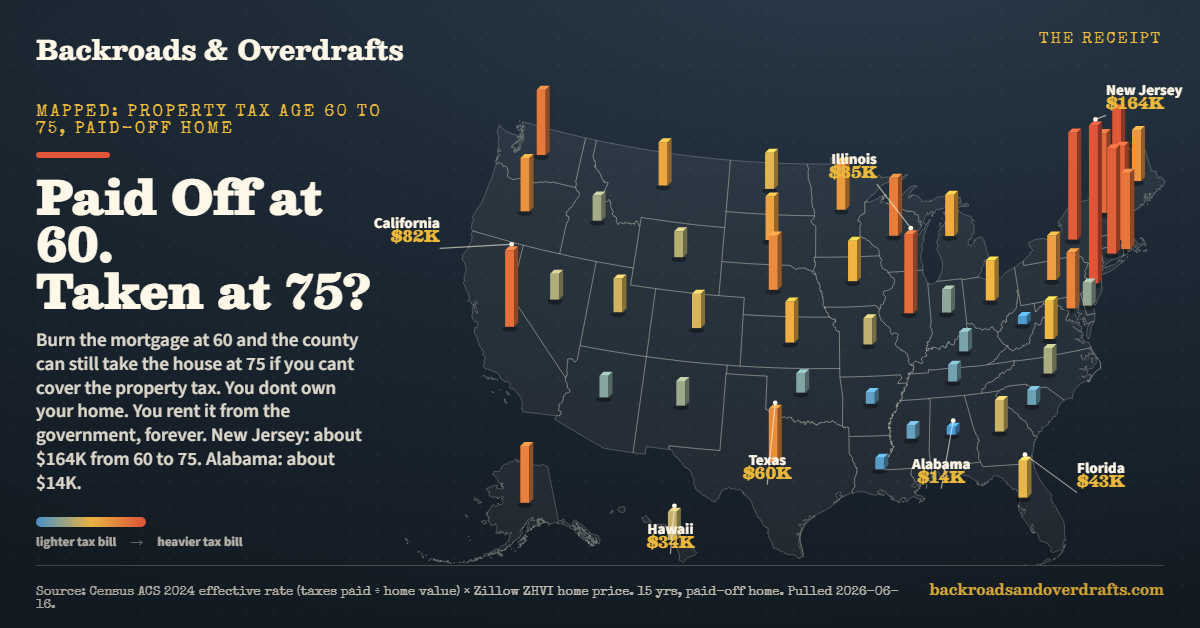
The House Is Paid Off. The Tax Never Is.
Pay off your mortgage at 60 and the county still bills you every year. We mapped what 15 years of property tax costs on a paid-off home in all 50 states. New Jersey, about $164,000. Alabama, about $14,000.